Fire Safety
Part B of UK Building Regulations covers fire safety in the UK Building Regulations. All pipe insulation materials should meet BS EN 13501-1 ‘Fire classification of construction products and building elements’. PAROC® pipe insulation exceeds this. PAROC® stonewool insulation products are non-combustible. When tested to EN 13501-1, PAROC® products offer the highest fire class, either Euroclass A1 or A2-s1,d0.
Why Compliance Matters
Building Regulations compliance is critical for any construction team’s success. It helps you provide energy-efficient, high-performing and safe buildings for everyone’s benefit. Whether you are specifying for a new build or retrofitting an existing system, understanding the regulatory landscape helps you make informed decisions. Decisions that benefit both your project and your clients.
For HVAC pipe insulation, using a specification and getting things right first time saves you time and money. As well as maintaining your professional reputation.
Poorly insulated pipes can lead to bigger problems:
- Building control failure, enforcement action and project delays.
- Costly revisits to make good or potential fines.
- Poor EPC or failing future inspections as part of the Energy Performance Building Directive (EPBD) for AC systems over 12kW.
- Fire safety risk from using combustible pipe insulation materials.
- Poor performance and energy efficiency, leading to potential indemnity claims.
How To Specify Compliant HVAC Pipe Insulation
1. Confirm operating levels
Temperature requirements. Heating, hot water, chilled water or condenser temperatures for supply and returns.
Setting and environmental conditions. Basement or roof, internal or external, high-temperature plant rooms, high moisture applications?
2. Check pipe insulation thickness
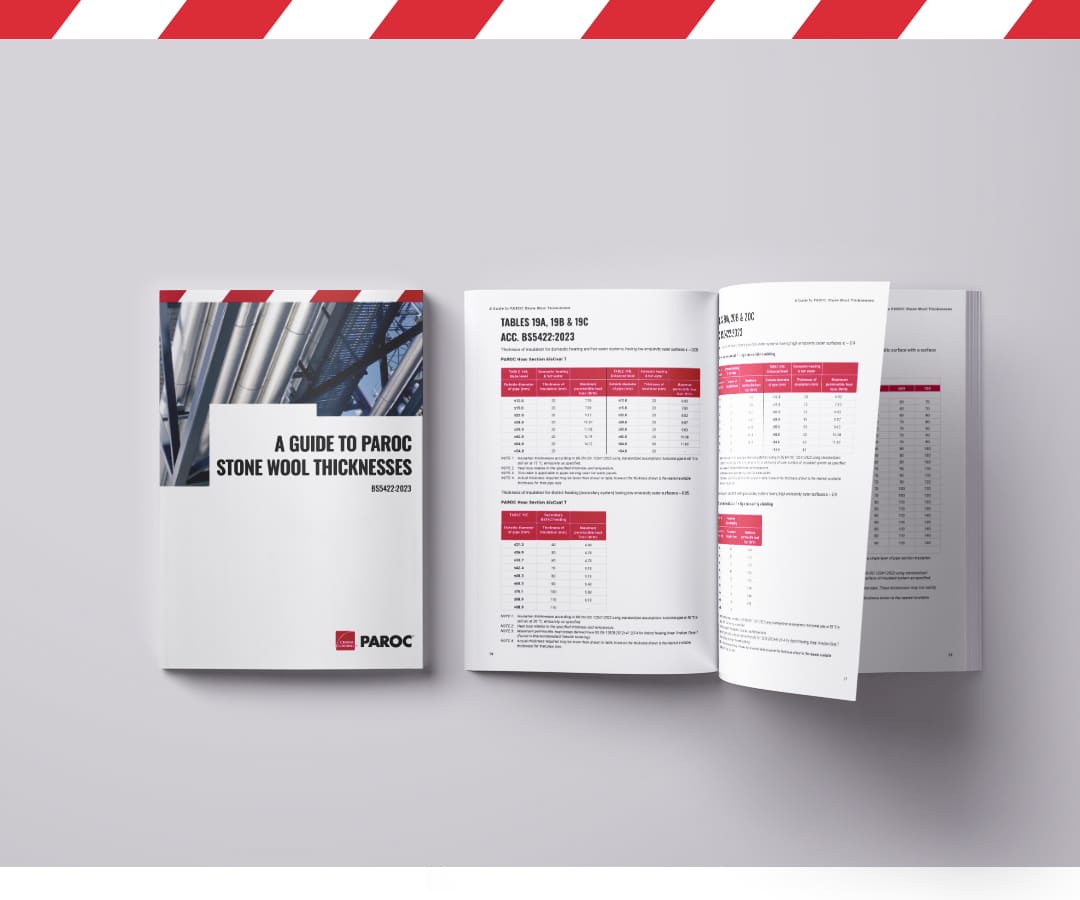
BS 5422:2023 provides thickness tables based on pipe diameter, operating temperature and surface emissivity.
Work out what thickness you need using our handy HVAC pipe insulation thickness guide.
3. Address fire safety requirements
For BS5422:2023 you must use materials rated B-s3,d2 or better under BS EN 13501-1. However, for some specific areas you must use non-combustible materials:
- Ceiling voids and service corridors.
- Escape routes and protected stairwells.
- Service penetrations through fire-rated elements.
- Plant rooms and boiler houses.
Stone wool pipe insulation is non-combustible and achieves the highest Euroclass rating - A1 or A2-s1,d0, unlike other insulation materials.
4. Account for moisture
- Prevent condensation on outer surfaces for chilled water applications.
- Plan to maintain thermal performance in high humidity.
- Limit moisture exposure in basement settings.
Stone wool’s structure repels liquid water and is still breathable. Any moisture from the construction stage can still evaporate.
5. Consider Long-Term Performance
Stone wool does not settle or compress throughout the building's lifecycle. Providing long-term durability and efficiency thanks to a consistent thickness and density.
Regular heating and cooling cycles do not affect stone wool performance either. The structure remains stable across the full BS 5422 temperature range.
Stone wool resists chemical damage from cleaning agents and other typical HVAC system additives.