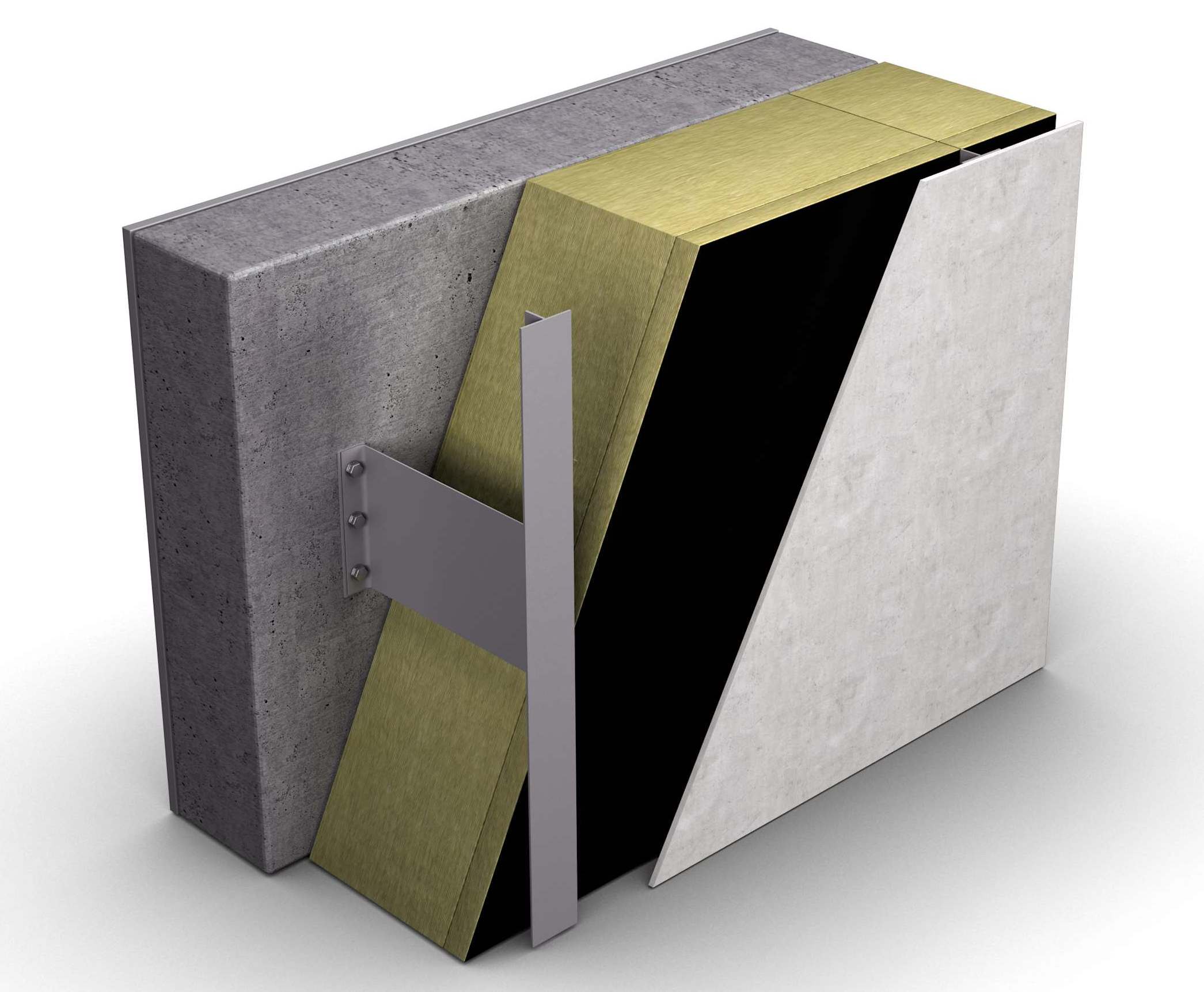
Bracket thermal conductivity highlights a core design question: how can the fixing system be designed to satisfy both imposed structural loads (e.g., wind, self-weight) and thermal requirements—without driving insulation thickness up unnecessarily?
Brackets as part of an energy-efficient facade solution
The conclusion is straightforward: if the goal is to optimize energy performance, brackets should be considered as part of the insulation system and thermal calculation because they drive the ΔU correction and therefore the required insulation thickness when targeting a certain U-value. This requires a move from component-level optimization to system-level design, where thermal, structural, and practical installation factors are addressed together.
“Essentially, the design comes down to an optimization problem: ensuring mechanical integrity while balancing energy efficiency and overall wall thickness. Ultimately, the best solution is the one that optimizes the project’s life‑cycle cost without compromising the architectural vision. That’s why facade performance cannot be optimized by looking at components in isolation,” adds Alex Lalla.
In practice, an effective approach is to optimize brackets as part of the whole facade system: reduce thermal bridging (material choice, thermal break), reduce the number of fasteners where structurally feasible, and ensure the thermal calculation (ΔU) matches the designed fastener setup.
Conclusions: from design intent to measurable performance
Closing the gap between calculated and actual performance requires an integrated approach in which the fixing system (brackets, fasteners, spacings), insulation, and ventilation cavity are designed together from the earliest stages.
Ventilated facades are systems: performance depends on how all the components work together. Details that look minor—such as bracket material and quantity—can have an outsized impact on overall heat transfer, which is why the “weakest link” in the overall thermal performance is often the fixing system.
What this means in practice (a checklist)
- Treat brackets and fasteners as part of the insulation system and thermal calculation (ΔU), not just load-bearing elements.
- Optimize bracket material and design (e.g., thermal breaks) to reduce thermal bridging.
- Do not rely on increasing insulation thickness alone—first identify whether ΔU can be reduced through the fixing solution.
- Balance thermal and structural requirements at a system level (loads, spacings, buildability, fire and moisture constraints).
- Make sure the designed fastener spacings and details are buildable on site and match the assumptions used in calculations.