For ratings A2-D, an additional class for smoke (s) and burning droplets (d) is also specified:
- s1–s3 – smoke production (low to high)
- d0–d2 – burning droplets (none to high occurrence)
An example product classification would be: A2-s1,d0
The Euroclass system is used for technical comparison of construction materials and, where applicable, forms part of the information for CE marking under the Construction Products Regulation ((EU) No 305/2011, CPR).
Resistance to fire - performance over time
While Euroclass describes reaction to fire in the early stages, fire resistance describes how long a construction, building element, or installation can withstand fire exposure over time. Fire resistance is classified according to EN 13501-2, and is based on the core criteria are:
R (Load-bearing capacity): how long the material supports weight during a fire.
E (Integrity): the material's ability to prevent the passage of fire and hot gases into unaffected areas.
I (Insulation): the material's capacity to prevent temperature increases on sides not directly exposed to fire.
Together, these form the REI classification. In addition to the core criteria, additional criteria may apply to specific performance requirements, for example:
S (Smoke): Airtightness and the prevention of smoke affecting other areas.
For the full list, refer to EN 13501-2.
Verified through standardised tests
Fire resistance is verified through standardised fire tests in which building elements and systems are exposed to controlled fire conditions for a defined period.
During testing, thermocouples, thermoelectric devices which measure temperature, are placed on specific areas according to the product’s appropriate testing standard. Temperature measurements are used to verify compliance with the insulation (I) criterion:
- no individual thermocouple may exceed 180 °Celsius above ambient temperature
- the average temperature rise of specified thermocouples may not exceed 140 °Celsius
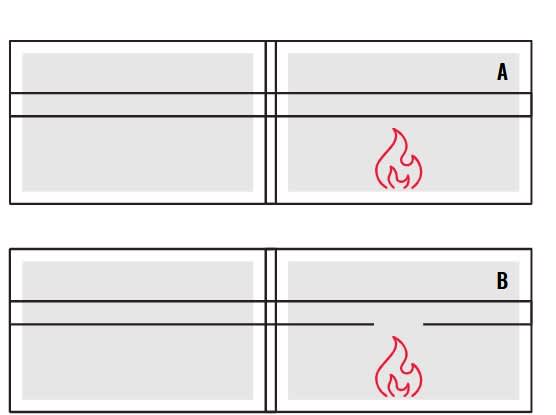
At the same time, integrity (E) is verified by ensuring that flames and hot gases do not pass through to the non-fire-exposed side.
Fire resistance is expressed as an EI classification with a time designation, for example EI 30, EI 60 or EI 120, indicating the duration for which both integrity and insulation requirements are met during testing. For example, a product with an EI 30 rating did not exceed 180 degrees during testing and maintained an average lower than 140 degrees and maintained integrity for at least 30 minutes. EI 60 for 60 minutes, EI 120 for 120 minutes.